Why ADHD Brains Struggle With Money (It's Not Willpower)

"I just need to be more disciplined with money" is one of the most common, and least helpful, things ADHD adults tell themselves. It's not a discipline problem. It's a predictable collision between how money works and how the ADHD brain works. Here's the actual mechanism, in four parts.
1. Checkout is a dopamine hit
ADHD brains run chronically low on baseline dopamine, the neurotransmitter behind motivation and reward. Buying something, the anticipation, the "add to cart," the notification that it shipped, delivers a real, measurable dopamine spike. That's not a weakness of character. It's the same mechanism that makes boring tasks feel unbearably hard to start: the brain is reaching for stimulation it's short on.
2. "Future me" doesn't feel real
ADHD is linked to a flattened sense of future time, deadlines and consequences that are more than a few days out don't carry the same emotional weight as things happening right now. That's why "future you" calmly paying off a credit card bill feels believable in the moment, even when present-you knows, abstractly, that the bill is coming. Autopay and automated savings transfers work so well for ADHD brains precisely because they don't require future-you to show up and remember anything.
3. Out of sight is out of mind, literally
Object permanence quirks (the same mechanism behind "I can't find my keys" even when they're on the counter) apply to money and possessions too. A grocery item in a crisper drawer might as well not exist. A receipt in a bag is functionally invisible. This is why "just remember to use it" fails as a strategy, and why visible systems (an eat-first shelf, a landing-zone bowl by the door) consistently outperform willpower-based ones.
4. Working memory drops the bill before it's paid
"I'll pay that tonight" is a genuine intention that evaporates by dinner, not because you didn't mean it, but because ADHD working memory has a smaller mental "clipboard" than a neurotypical brain, and new information constantly bumps old information off of it. A bill you looked at at 9am can be completely gone from working memory by 9pm, with no warning that it happened.
What to do with this
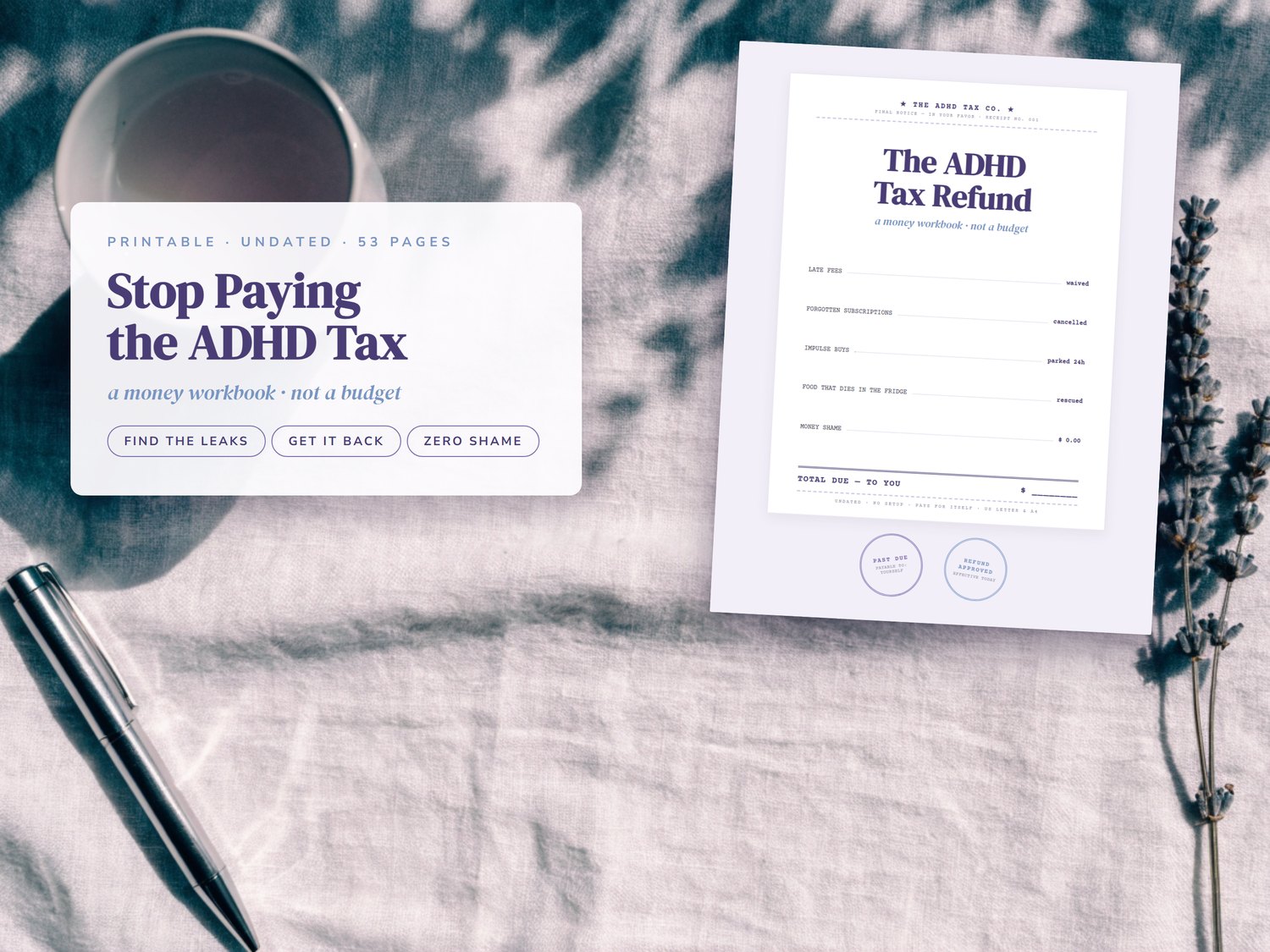
Once you know the mechanism, the fix stops being "try harder" and starts being "build a system that doesn't need me to remember." That's the entire premise behind The ADHD Tax Refund, five small, concrete systems, each aimed at one of these exact mechanisms.